Labouré Expands Access to Nursing Education with New Advanced Vocational ESOL Program
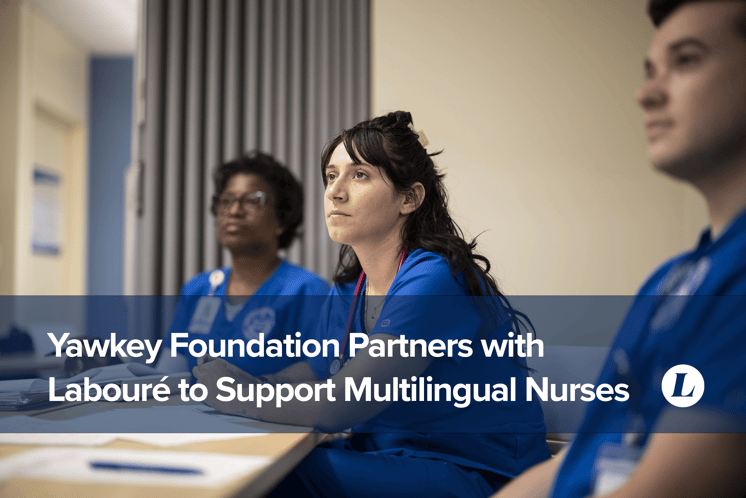
Labouré College of Healthcare is excited to announce the development of an innovative Advanced Vocational ESOL (English for Speakers of Other Languages) strategy designed specifically to support students in a two-year nursing degree program. The result will be the elimination of a persistent barrier preventing immigrant talent from becoming critically needed, multilingual nurses in the Commonwealth.
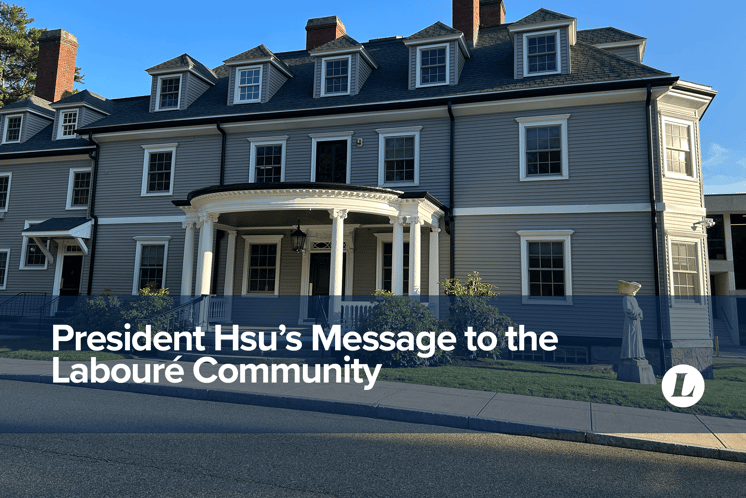
“With federal funding cuts and uncertainty around the basic services our students rely on, there is one thing Labouré can do, and that is further increase access to well-paying careers for our students, giving them the opportunity to reach financial independence and security for themselves and their children,” said Labouré President Lily S. Hsu, EdD.
“Our Advanced Vocational ESOL for Nurses program is one strategy to further expand opportunities and access for our students. We are grateful for the continued support of our local legislative delegation – Senator William Driscoll and Representative Richard Wells – and the Healy-Driscoll administration for recognizing the need to expand access to vocational-based English language courses so that these talented individuals can fulfill critical workforce needs.”
ESOL offerings often conclude at “survival English” or a Student Performance Level (SPL) 6, yet healthcare roles, such as Registered Nurse, require a SPL 8-9. A 2020 survey by The Boston Foundation and the Latino Legacy Fund found that of the hundreds of ESOL programs in Massachusetts, only 7% prepare English Language Learners (ELLs) for advanced, vocational-based English – none of which are focused on what students need to earn a nursing degree.
“A nurse who can clearly communicate with their patients and who understands the customs and traditions of our local cultures is invaluable. The impact that this shared understanding, trust, and clarity of communication has on health outcomes is limitless,” said Eileen Costello, DNP, RN, Dean of Nursing at Labouré College of Healthcare.
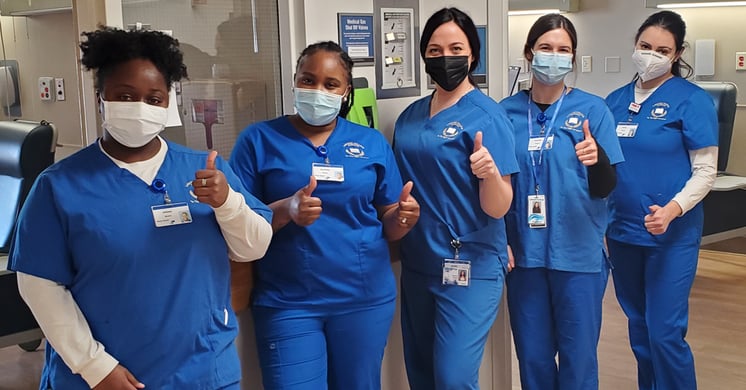
Unable to find an existing program that encompassed the unique needs facing English Language Learners in a nursing degree program, Labouré chose to develop its own program tailored to its student population. Labouré nurses are changing the racial and cultural profile of Massachusetts’ nursing workforce. Approximately 68% of Labouré students identify as people of color and 45% are multilingual, speaking predominately Haitian Creole, Spanish, Portuguese, and French.
In December 2024, the college hosted a strategy luncheon with key figures in Greater Boston’s immigrant services and ESOL education. Representatives from MassINC, Catholic Charities Boston, English for New Bostonians, First Literacy, and ABCD Boston met to envision what an ESOL program fully contextualized in a 2-year nursing degree program would entail.
The Advanced Vocational ESOL for Nurses initiative is the formalization of the work already being done at the college, with seed funding secured from the Yawkey Foundation, the Highland Street Foundation, and the Executive Office of Health and Human Services in Massachusetts. The curriculum is currently being developed with an anticipated rollout in Fall 2026.
Addressing Health Equity and Social Determinants of Health
“When you come to a hospital or healthcare facility and you don't speak English, you are scared. But when you see a person or familiar face that can speak your language, that's reassuring and you feel like ‘...I trust that I am going to get better.’ That is going to help the patient mentally and physically,” said Labouré alumna, Marie Roche Daniel, RN ’22, BSN ’25 who speaks Haitian Creole, French, and Spanish in addition to English. (Watch Marie discuss why multilingual nurses matter.)
Multilingual nurses play a critical role in Boston-area and Gateway City hospitals, nursing homes, long-term care facilities, and community health centers. The Massachusetts Attorney General’s Office report Building Toward Racial Justice and Equity in Health: A Call to Action explores data from several studies that demonstrate that a “lack of diversity in the health care workforce poses real risks for the health outcomes of people of color.”
Census data shows that nearly 68 million people spoke a language other than English at home in 2019 – or about 21.6% of the total population. In census data for Massachusetts, nearly 25% of the state population reported speaking a language other than English at home – higher than the national average.
“We have a lot of patients who don't know any English, so they are panicked when they come in. Because I speak Cantonese and Mandarin, they feel comfortable talking to me. I feel like I have some purpose in helping our Chinese patients; I can support them and their family members,” explains Mike Lee, RN`22, BSN, staff nurse at Beth Israel Deaconess Medical Center, who says that without Labouré, he would not have had access to this career. Labouré was the only college in the state that accepted Lee due to his English proficiency. By the time he was halfway through the nursing program, he was tutoring his classmates on nursing concepts. (Watch Mike's story.)
The Department of Health and Human Services Healthy People 2030 “sets data-driven national objectives to improve health and well-being over the next decade.” One of these objectives is Language and Literacy, which falls under one of many Social Determinants of Health (SDOH) – Education Access and Quality. The SDOH report on Language and Literacy recognizes that “having limited English proficiency in the United States can be a barrier to accessing health care services and understanding health information” and notes that “quality of care is lowered when patients do not understand their health care providers, when patients and providers do not speak the same language, and when a provider’s approach is not linguistically competent,” citing several published studies. “Patients with limited English proficiency may receive lower-quality mental health care due to inadequate interpretation services, as interpreters may ‘normalize’ or omit pathological symptoms from their interpretations. However, trained interpreters and bilingual health care providers improve patient satisfaction, quality of care, and health outcomes for individuals with limited English proficiency.”
“As a Latina, I recognize the importance of diversity in the nursing field. I notice a huge relief in [the patients] when they know that I speak their native language; that helps them feel much more comfortable in asking questions, and it helps with the learning process. I think that's very important when you're teaching a patient,” said Joeimy Bloom, MSN, FNP-BC, Labouré alumna (RN ‘21, BSN ‘22). (Watch Joeimy's story.)
Eliminating a Barrier to Healthcare Worker Advancement
Labouré’s program was inspired by the needs of its students and validated by MassINC's 2025 report Massachusetts Needs an Actionable Strategy to Expand ESOL Services, which points to the lack of advanced, vocational-based English for Speakers of Other Languages (ESOL) education as preventing many residents from advancing their careers.
English proficiency is a hurdle for Certified Nursing Assistants (CNAs) and Home Health Aides (HHAs) hoping to become RNs. In Massachusetts, this is an average salary increase from approximately $42,000 to over $100,000. Labouré’s program will serve these workers in the Greater Boston area.
“The care nurse aides provide, for the salary they receive, is proof of their commitment and compassion for others. They deserve access to the education and training necessary to advance and earn a salary that can support their families. We can help them in improving their English comprehension - what cannot be taught is what they already have”, says Katelyn Dwyer, Executive Director of Advancement at Labouré. Approximately 60% of Labouré students currently work in healthcare, often as CNAs, HHAs, and Medical Technicians.
Labouré alumna Georgia Nuahn, RN `19 worked as a CNA at Boston Medical Center when she arrived in the US from Liberia with her children. “When I got hired at Boston Medical Center, there was an older patient speaking something I thought sounded familiar,” said Nuahn. “It was my dialect from Liberia. She was refusing her meds, refusing to eat, but when I started speaking to her in her language, her eyes lit up. I explained to her the benefits of what we were trying to do, so she felt safe. At first, she wouldn’t let anyone do anything for her, but I gave her a shower and braided her hair, and she looked like a whole different person. Being in the hospital, and being sick, and seeing someone that speaks like you, and looks like you – that’s a healing in itself.” (Watch Georgia's story here.)
Addressing a Need in Massachusetts
The benefits of a multilingual workforce extend beyond the realm of healthcare. In July 2025, the Healy-Driscoll Administration announced a $10 million investment to expand access to workforce training programs and provide career-related ESOL training to thousands of individuals in Massachusetts over the next two years. In addition, Governor Healy approved within the 2026 state budget an earmark of $75,000 for Labouré College of Healthcare to develop the Advanced Vocational ESOL for Nurses program to increase the MA nursing workforce recruitment pipeline through increased access to nursing careers.
“We have employers across Massachusetts who need skilled talent to fill open positions. Connecting workers with training programs and English classes will make sure they have the skills that employers are looking for in today’s economy,” said Governor Maura Healey.
“We know adult education helps families and our economy succeed. With this funding, we’re expanding access to the skills and supports that English learners need to get jobs,” said Lieutenant Governor Kim Driscoll. “This investment is about creating pathways to success and supporting a workforce for employers in our state.”
"Investments in workforce training and English for Speakers of Other Languages (ESOL) programs do not just benefit immigrants, but all of Massachusetts. Our state needs more workers in frontline industries like healthcare, and immigrants are eager to fill those jobs, strengthening our economy and taking care of those in need,” said Massachusetts Immigrant and Refugee Advocacy Coalition Executive Director Elizabeth Sweet in a statement of support for the Governor’s announcement.
-----
Labouré College of Healthcare provides the largest pipeline of associate-degree nurses in the state (over 1,500 since 2020) and these students mirror the cultures and ethnicities of Boston's patient population on a scale unmatched by any nursing program in New England.
“A diverse nursing workforce directly improves the health of our local populations,” said Hsu. “The impact of Labouré’s mission is that millions of patients are served with compassion by nurses who look like them, understand their culture, and speak their language.”
During Labouré’s 2025 Commencement Ceremony, Senior Vice President and Chief Nursing Officer at Boston Medical Center Nancy Gaden, DNP, RN NEA-BC, FAAN shared her insight with graduates about what it means to be a nurse today. “Nursing is more than just the clinical skills,” said Gaden. “It is the art of truly seeing the person behind the patient, understanding their stories, and caring for them with dignity and respect. Labouré students are special when they come into our profession because they bring their whole rich history and perspective to their patients. They are empathetic, multicultural, talented, amazing people – and they are a gift to the nursing workforce.”
About Labouré College of Healthcare
Funding for the Advanced Vocational ESOL program was provided by the Yawkey Foundation, the Highland Street Foundation, and the Executive Office of Health and Human Services in Massachusetts, as well as other sources. The college continues to raise funds to remove educational and financial barriers to nursing education through the Care for the Future campaign.
Established in 1892, Labouré College of Healthcare is home to the largest and longest-running associate degree nursing program in the Boston area. Our students are adults juggling courses with work and family commitments. More than 90% are from the local Greater Boston area, and they mirror the patient population of Boston on a scale unmatched by any nursing program in New England.
Labouré is a private, independent, 501(c)3. Located in Milton, Massachusetts, the college offers bachelor's and associate degree programs in nursing and healthcare both on-campus and online.
To learn more about Labouré College of Healthcare, the Care for the Future campaign, or the Advanced Vocational ESOL (English for Speakers of Other Languages) for Nurses program, please contact Katelyn Dwyer, Executive Director, College Advancement, katelyn_dwyer@laboure.edu, 617-207-3676.
www.laboure.edu


Comments